

What Grade Is 9/10? It’s 90% — A− or A, Depending on Your School
What Grade Is 9/10? It’s 90% — an A− or an A, Depending on Your School
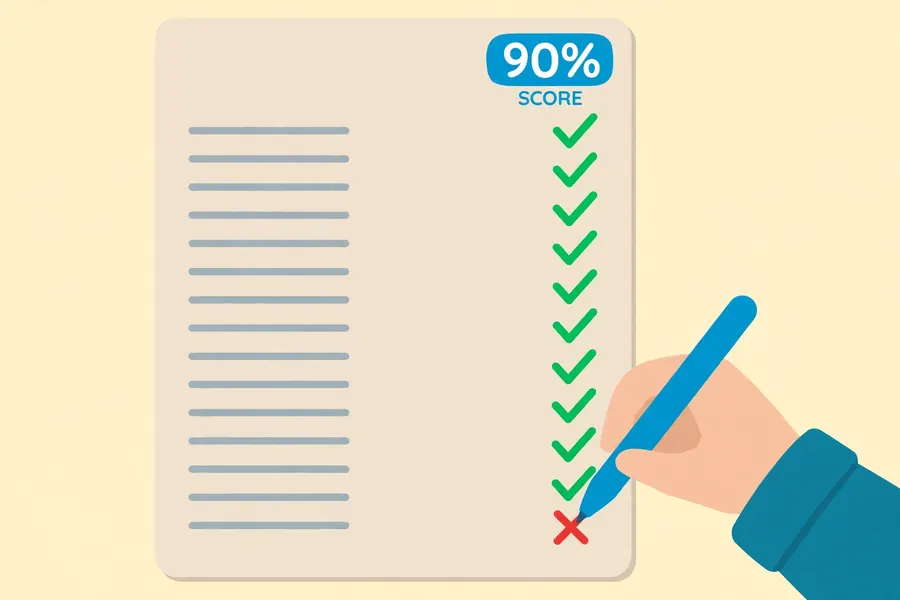
What grade is 9/10? Short answer: 9/10 is 90%, which is an A− on a plus/minus grading scale and a plain A on a straight scale with no plus or minus grades. Either way, it is an excellent result. A 9/10 means you got nine answers right and only one wrong, and on a ten-question quiz that single mistake still leaves you right on the A boundary — the exact line where the two grading scales disagree.
This guide works out the maths step by step, gives you the full ten-question score table, explains why the same paper is an A− in one school and an A in another, shows how much a 9/10 actually moves your class grade, and answers the questions students really ask about short quizzes, exit tickets, and spelling tests.
How to Work Out 9/10 as a Percentage
The formula for any test score is the same:
Percentage = (correct answers ÷ total questions) × 100
For 9 out of 10, that is:
9 ÷ 10 × 100 = 90%
There is no rounding involved here, and no awkward decimal to argue about. Unlike scores such as 13 out of 15 (86.67%), where teachers disagree about rounding up to 87%, 9/10 lands exactly on 90%. That exactness is part of why students search for it: 90% is a boundary number, and boundaries are where grading scales start to disagree with each other.
Try it yourself with any short quiz score:
10-Question Quiz Calculator
If you want to check any other test size, not just a ten-question quiz, use the Test Grade Calculator — enter the total questions and the number wrong, and it gives you the percentage, the letter grade, and the full chart for that test.
The Full 10-Question Quiz Score Table
On a ten-question quiz where every question counts equally, there are only eleven possible scores, and each one is a clean multiple of ten. That makes the table short — and it also makes it unforgiving, as you will see below.
| Correct | Wrong | Percentage | Letter grade (plus/minus scale) | GPA points |
|---|---|---|---|---|
| 10 | 0 | 100% | A+ | 4.0 |
| 9 | 1 | 90% | A− | 3.7 |
| 8 | 2 | 80% | B− | 2.7 |
| 7 | 3 | 70% | C− | 1.7 |
| 6 | 4 | 60% | D− | 0.7 |
| 5 | 5 | 50% | F | 0.0 |
| 4 | 6 | 40% | F | 0.0 |
| 3 | 7 | 30% | F | 0.0 |
| 2 | 8 | 20% | F | 0.0 |
| 1 | 9 | 10% | F | 0.0 |
| 0 | 10 | 0% | F | 0.0 |
Letter grades and GPA points use the standard scale used across this site: A+ 97–100 (4.0), A 93–<97 (4.0), A− 90–<93 (3.7), B+ 87–<90 (3.3), B 83–<87 (3.0), B− 80–<83 (2.7), C+ 77–<80 (2.3), C 73–<77 (2.0), C− 70–<73 (1.7), D+ 67–<70 (1.3), D 63–<67 (1.0), D− 60–<63 (0.7), F below 60 (0.0). As always, letter grades depend on your school’s own scale — these are the standard values, and your syllabus is the final word for your class.
Look closely at that table and you will notice something strange: most letter grades never appear. There is no plain A, no B+, no B, and no C on a ten-question quiz, because no number of correct answers produces 93%, 88%, 85%, or 75%. The quiz jumps straight from 90% to 80%, from an A− to a B−, with nothing in between. That coarse jumping is the defining feature of short quizzes, and it explains a lot of the frustration students feel about them. One extra wrong answer does not cost a few points here — it costs a whole letter-grade step, from A− to B−, because each question is worth a full 10%.
Why 9/10 Is an A− in One School and an A in Another
The disagreement is not about the maths. Everybody agrees 9/10 is 90%. The disagreement is about what 90% is called, and that depends on which of the two common grading scales your school uses.
The plus/minus scale: 90% is an A−
On a plus/minus scale, the A band is split into three parts: A+ for 97–100%, A for 93–96%, and A− for 90–92%. A score of exactly 90% sits at the very bottom of the A band, so it earns the lowest A available: an A−, worth 3.7 GPA points instead of 4.0. This is the scale used across this site, and it is the scale many American high schools and colleges use, because it gives teachers finer distinctions between strong performances.
Under this scale, a student who scores 9/10 on every quiz finishes with an A− average, not an A average — even though they never scored below 90%. That surprises students, but it follows directly from the scale: 90% is inside the A− range, so an A− is what it is.
The straight scale: 90% is a plain A
On a straight scale, there are no plus or minus grades at all. The bands are simply A for 90–100%, B for 80–89%, C for 70–79%, D for 60–69%, and F below 60%. On that scale, 90% is comfortably inside the A band, so 9/10 is a plain A, worth the full 4.0 GPA points.
Many elementary schools, some high schools, and some colleges use a straight scale, partly because it is simpler to explain and partly because it avoids exactly this kind of boundary argument. If your school uses a straight scale, a 9/10 is an A, full stop, and you do not lose the 0.3 GPA points that the plus/minus scale takes away.
Other variations you may meet
A few schools shift the cut-offs slightly. Some use 90–94% for A− and 95–100% for A; some treat 90% as the top of the B+ range and require 91% or more for an A−, though that is much less common. A small number of schools grade ten-question quizzes out of a different total — for example, counting a quiz as 10 points but awarding partial credit, so a student can score 9.5 out of 10 (95%, an A) even though a whole-question table shows no such score. None of these change the core answer: 9/10 is 90%, and 90% is an A-band score on every standard scale. The only question is whether your school splits the A band, and if it does, 90% is the A− end of it.
The practical advice is simple: check your syllabus or ask your teacher which scale applies before you worry about the difference. If you are checking a score against the standard scale, the Letter Grade Calculator converts any percentage to its letter grade and GPA points instantly.
Is 9/10 a Good Grade?
Yes — by any reasonable measure, 9/10 is a good grade, and in most contexts it is an excellent one. But “good” means slightly different things at different school levels, so it is worth breaking it down.
In elementary and middle school
In the early grades, a 9/10 on a spelling test, a maths drill, or an exit ticket is a strong result. Teachers at this level are usually checking whether the material has landed, not ranking students, and nine correct out of ten says it has. A pattern of 9/10 scores tells a teacher the student understands the work and only slipped on one item — perhaps a careless error, perhaps one concept that needs a second look. Either way, it is not a cause for concern, and it is certainly not a grade a parent needs to worry about.
In high school
In high school, 9/10 is still a strong grade, but the context matters more. On a low-stakes quiz, it is an A-band result and it helps your average. On a major test, the same logic holds — but high school students should notice the GPA difference the scale makes. On a plus/minus scale, a course average of exactly 90% is an A− (3.7), not an A (4.0). Over a full transcript, the difference between a 3.7 and a 4.0 in one course is small — roughly 0.06 GPA points across five courses, as worked out below — but students aiming for the very top of their class do notice it, and that is why the A− versus A question gets asked so often.
In college
In college, a 9/10 quiz score is a good grade, and it is usually a small part of the course. College courses rarely rest on a single ten-question quiz; they combine quizzes, homework, midterms, and finals, often with the quizzes worth only 10–20% of the total. A 9/10 on one quiz in that mix is a solid contribution, not a deciding factor. The exception is a course where a quiz average below a threshold blocks progress — for example, a programme that requires a B average to stay in good standing — but even there, a 90% average clears the bar comfortably.
When 9/10 is not quite enough
There are only a few situations where 9/10 falls short, and they are all about thresholds rather than the grade itself. If a scholarship, an honours track, or a programme requires a straight-A average with no A− grades, then a 90% average is technically short, even though it is only one step below an A. If a single quiz is graded as pass or fail at a 95% cut-off — rare, but some mastery-based courses do this — then 90% would not pass that one quiz, though the student would normally get a chance to retake it. And if the quiz was meant to be easy revision and the whole class scored 10/10, a 9/10 is still good, but it is below the class average — which is a different kind of information, about one question you missed rather than about your overall standing.
How Much Does a 9/10 Actually Move Your Class Grade?
This is the question students really care about after the letter grade, and the answer depends entirely on how much the quiz is worth. A 9/10 is 90%, so it pulls your average toward 90%: up if you were below 90%, down if you were above it, and not at all if you were already exactly at 90%.
Worked example 1 — a quiz worth 10% of the grade. Suppose your class average before the quiz is 88%, and you score 9/10 (90%) on a quiz worth 10%. Your new average is (88 × 0.90) + (90 × 0.10) = 79.2 + 9 = 88.2%. The quiz lifted you by just 0.2 points — a small nudge, because the quiz is a small slice of the grade.
Worked example 2 — the same quiz, from above 90%. Now suppose your average before the quiz is 92%, and you score the same 9/10. Your new average is (92 × 0.90) + (90 × 0.10) = 82.8 + 9 = 91.8%. The quiz cost you 0.2 points. That feels unfair — you scored an A-band grade and your average still fell — but it is just the maths of averaging: anything below your current average pulls it down, even a good score. The drop is tiny, and it reverses the moment you score above your average again.
Worked example 3 — a quiz worth 20% of the grade. With a bigger weight, the same 9/10 moves things more. From an 85% average, a 90% quiz worth 20% gives (85 × 0.80) + (90 × 0.20) = 68 + 18 = 86%, a full point higher. From a 95% average, the same quiz gives (95 × 0.80) + (90 × 0.20) = 76 + 18 = 94%, a full point lower. Weight is what turns a small quiz score into a visible change, which is why the same 9/10 can feel like a boost in one class and a dent in another.
Worked example 4 — points-based classes. Many classes do not use category weights at all; they add up points. Suppose you have 340 points out of 400 so far (85%), and you score 9 out of 10 on the next quiz. You now have 349 points out of 410, which is 85.12% — up just 0.12 points, because the quiz is a small fraction of a large total. Early in a term, when the total is small, one quiz moves the average much more; late in a term, when hundreds of points are already banked, even a perfect quiz barely moves it. That is the same principle behind how much one bad test lowers your grade: the weight of the item, and how much is already in the average, decide the damage or the benefit.
The general lesson is reassuring: a single 9/10 almost never changes your class grade by more than a point or two, in either direction. If you want to plan exactly what you need on the remaining work to reach a target grade, the Final Grade Calculator works it out from your current grade, the weight of the remaining work, and your target.
Why Teachers Love the 10-Question Quiz
Ten questions is the classic short-quiz size for a reason. It is long enough to test whether students did the reading or understood the lesson, and short enough to give, mark, and return inside a single class period. Teachers use ten-question quizzes as exit tickets at the end of a lesson, as spelling tests, as vocabulary checks, as warm-up reviews, and as quick checks before moving on to harder material. The format is so common that whole grading tools are built around it — the Teacher Grader and the EZ grader chart both exist largely because teachers grade stacks of short quizzes every week.
But the ten-question format has a real weakness, and the table above shows it: the grades jump in 10% steps. A student who knows 85% of the material cannot show 85% on a ten-question quiz — they can only show 80% or 90%. Teachers handle this in several ways. Some award partial credit, so a mostly-correct answer earns half a question and the score can land on 85% or 95%. Some make questions worth different points, so a hard question counts double and the total is no longer ten equal steps. Some average several short quizzes together, so the coarse steps smooth out across the term: a student scoring 9, 8, 9, and 10 across four quizzes averages 90%, but the individual quizzes still jump around. And some teachers simply accept the coarseness, because the quiz is a quick check, not a precise measurement.
For students, the practical takeaway is this: do not over-read a single ten-question quiz. An 8/10 (80%, B−) on one quiz does not mean you are a B− student, any more than a 9/10 means you are an A− student. It means you missed two questions on one short check, and the quiz format turned that into a 20-point swing from a perfect score. Look at your average across quizzes, not at any single one.
9/10 Compared With the Same Percentage on Longer Tests
It helps to see 9/10 alongside the other scores that also equal 90%, because the percentage is identical but the experience is very different:
| Score | Percentage | Letter (plus/minus) | What one wrong answer costs |
|---|---|---|---|
| 9/10 | 90% | A− | 10% |
| 18/20 | 90% | A− | 5% |
| 45/50 | 90% | A− | 2% |
| 90/100 | 90% | A− | 1% |
Every one of these is 90% and an A− on the plus/minus scale, and every one is a plain A on a straight scale. The difference is purely how much each mistake costs. On a ten-question quiz, one slip costs 10% and drops you from a perfect score to the A− boundary in a single step. On a hundred-question exam, one slip costs 1% and leaves you at 99%, still an A+. That is why students feel short quizzes are harsh: they are, arithmetically, much harsher per mistake than long exams, even when the teacher intends no harshness at all.
If you want the full story of the 20-question version, read What Grade Is 18/20? — it covers the same 90% boundary in twice the detail, including the rounding and boundary arguments that matter more when the test is longer. And if you grade short quizzes yourself, the EZ Grader Chart Explained guide shows the charts for 10, 20, 25, 50, and 100-question tests side by side.
What About 9.5/10, Extra Credit, and Weighted Questions?
Real classrooms are messier than the clean table above, so three common variations are worth covering.
Partial credit. If your teacher awards half credit for a partly-correct answer, you can score 9.5 out of 10, which is 95% — an A on the plus/minus scale. Partial credit is the main way teachers soften the coarse ten-question steps, and it is worth asking about: a student who loses half a question instead of a whole one jumps from 90% to 95%, a full letter step, on the strength of one marking decision.
Extra credit. If a quiz carries an extra-credit question, the total can exceed ten points, and a score of 10 out of 10 plus a bonus question can read as 11/10, or 110% on paper. Most teachers cap the recorded grade at 100% (A+), and the extra point simply protects against a slip elsewhere. Do not expect an 11/10 to count as more than 100% in your average unless your teacher says so explicitly.
Weighted questions. If some questions on a ten-question quiz are worth more than others — say, two questions worth two points each and eight worth one point, for a twelve-point total — then “9 out of 10 questions correct” no longer equals 90%. It depends on which questions you missed. Missing a double-weighted question costs twice as much as missing a single-weighted one. In that case, add up the points you earned, divide by the total points, and multiply by 100 — the same formula, but with points instead of question counts. The Class Grade Calculator handles exactly this kind of points-based scoring.
Common Mistakes With 9/10
1. Confusing 9/10 with 9/20. A 9 out of 20 is 45%, an F — less than half the value of 9/10. The numerator alone tells you nothing; the denominator decides everything. Students searching in a hurry sometimes type the wrong total into a calculator and panic over a failing grade they do not actually have.
2. Assuming 90% is always an A. It is an A on a straight scale, but only an A− on a plus/minus scale, and that 0.3 GPA-point difference matters for students tracking a precise GPA. Check the scale before you claim the grade.
3. Assuming 90% is always a 4.0. On a plus/minus scale, only 93% and above earns 4.0 points. A 90% earns 3.7. If you are working out your GPA, use the GPA points column of the table, not the assumption that every A-band grade is worth 4.0.
4. Treating one quiz as the whole story. A single 8/10 or 9/10 on a ten-question quiz is a coarse measurement. Two wrong answers look like a B−, but across five quizzes the same student may average 90%. Judge the pattern, not the single quiz.
5. Forgetting that quiz weight decides the impact. A 9/10 on a quiz worth 5% of your grade and a 9/10 on a quiz worth 25% are the same score with very different consequences. Always check the weight before deciding whether a quiz result matters.
How 9/10 Affects Your GPA: A Worked Example
A single quiz does not directly change your GPA — your GPA comes from your final course grades, not from individual quizzes. But it is worth seeing how an A− course grade, the kind a steady run of 9/10 quizzes produces, compares with an A course grade across a transcript.
Imagine a student takes five 3-credit courses in one term. In four of them they earn an A (4.0 points each), and in the fifth they earn an A− (3.7 points). Their GPA is (4 × 3 × 4.0 + 1 × 3 × 3.7) ÷ 15 = (48 + 11.1) ÷ 15 = 59.1 ÷ 15 = 3.94. If that fifth course had also been an A, the GPA would be a perfect 4.0. So one A− instead of an A across five courses costs 0.06 GPA points for the term — noticeable to a student chasing a perfect record, but small in the context of a whole degree, and easily outweighed by a strong term elsewhere. You can check your own figures with the GPA Calculator, or, if you already have a GPA from past terms, the Cumulative GPA Calculator shows what a new term does to your overall figure.
And if your goal is to lift a GPA rather than just understand it, the Raise GPA Calculator tells you the exact GPA you need in your remaining courses to hit any target — the same kind of planning that turns a vague “do better” into a number you can actually aim at.
Frequently Asked Questions
What grade is 9/10?
9 out of 10 is 90%, which is an A− on a plus/minus grading scale (90–92%, 3.7 GPA points) and a plain A on a straight scale with no plus or minus grades (90–100%, 4.0 points). Either way it is an A-band, excellent grade.
Is 9/10 an A or an A−?
Both, depending on your school. On a plus/minus scale it is an A−, because the A band is split into A+ (97–100%), A (93–96%), and A− (90–92%). On a straight scale it is a plain A, because the whole 90–100% range is one grade. Check your syllabus to see which scale your school uses.
Is 9/10 a good grade?
Yes. Nine correct out of ten is an excellent result on any short quiz, spelling test, or exit ticket. It means you understood almost all of the material, and it sits in the A band on every standard grading scale.
What GPA is a 9/10?
A 9/10 quiz score itself does not have a GPA — GPA comes from final course grades. But a course average of 90% is worth 3.7 GPA points on a plus/minus scale (A−) and 4.0 points on a straight scale (A).
How many questions can you miss on a 10-question quiz and still get an A?
On a plus/minus scale, you can miss only one question and still hold an A-band grade (9/10 = 90% = A−). Miss two and you fall to 80%, a B−, because each question is worth 10%. For the full miss budgets on every common test size, see how many questions you can miss and still pass, or still get an A.
Why does one wrong answer hurt so much on a 10-question quiz?
Because each question is worth 100 ÷ 10 = 10%. On a 100-question exam the same mistake costs only 1%. Short quizzes are unforgiving by arithmetic, not by teacher choice — and that is why teachers often use partial credit or average several short quizzes together.
Is 9/10 better than 18/20?
No — they are exactly the same grade. Both are 90%, both are an A− on a plus/minus scale and an A on a straight scale. The only difference is granularity: on a 20-question test each mistake costs 5% instead of 10%, so the grades between 80% and 90% (85%, for example) become possible.
Want to check any score against the standard scale? Try the Letter Grade Calculator for the letter and GPA points, or browse every tool on the Grade Calculators hub.