
How to Calculate Your Grade With Extra Credit
To calculate your grade with extra credit, first check how your teacher applies the bonus. If extra credit adds to your earned points without changing the points possible, add the bonus to your score, divide by the original total, and multiply by 100. Bonuses applied to a weighted category or directly to your course percentage use different calculations.
Bonus-points formula
New grade (%) = [(Points earned + Extra credit points) ÷ Original points possible] × 100
Use this formula only when extra credit does not increase the points possible.
For category-based grades, use our weighted grade calculator after calculating the adjusted category percentage.
Check How Your Teacher Applies Extra Credit
Five extra-credit points do not always raise your course grade by five percentage points. Their effect depends on where the bonus is applied.
Check your syllabus or ask your teacher which method your class uses.
| Extra-credit method | How it works | Example |
|---|---|---|
| Bonus earned points | Add points earned. Keep points possible unchanged. | 80/100 plus 5 bonus points becomes 85/100 |
| Course percentage-point bonus | Add the stated bonus directly to the course percentage. | 80% plus 2 percentage points becomes 82% |
| Weighted-category bonus | Adjust one category, then apply its course weight. | Homework rises by 5 percentage points in a category worth 20% |
| Additional assignment | Add both earned and possible points if the assignment counts that way. | 80/100 plus a 5/5 assignment becomes 85/105 |
The additional-assignment method differs from pure bonus credit because it changes the denominator. Your teacher’s policy determines which calculation applies.
Extra Credit Added Directly to Your Course Percentage
If your course grade is 84% and your teacher awards two percentage points of extra credit, your new grade is:
84% + 2 percentage points = 86%
This differs from adding two raw points to an assignment. It also differs from increasing your grade by 2% of its current value:
84 × 1.02 = 85.68%
If your teacher says “2% extra credit,” confirm whether they mean two percentage points or a relative 2% increase.
Calculate Your Grade With Extra Credit Using Points
In a points-based class, your grade comes from total points earned divided by total points possible.
Suppose you have:
- 430 points earned
- 500 points possible
- 20 extra-credit points, added only to earned points
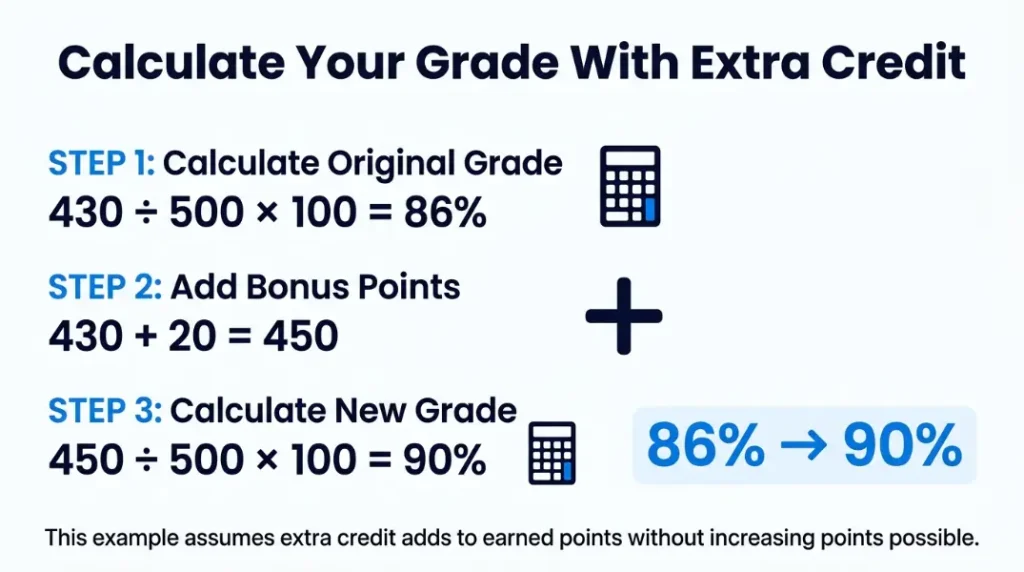
Your original grade is:
430 ÷ 500 × 100 = 86%
Add the bonus:
(430 + 20) ÷ 500 × 100 = 90%
Your grade increases by four percentage points, from 86% to 90%.
How Much Is Five Points of Extra Credit?
The same five bonus points can have different effects depending on the total points possible.
| Original score | Score after 5 bonus points | Grade increase |
|---|---|---|
| 40/50 = 80% | 45/50 = 90% | 10 percentage points |
| 80/100 = 80% | 85/100 = 85% | 5 percentage points |
| 400/500 = 80% | 405/500 = 81% | 1 percentage point |
When possible points stay unchanged:
Grade increase in percentage points = Extra credit points ÷ Points possible × 100
Knowing the bonus alone is not enough. You also need the total points possible.
Calculate Extra Credit in Weighted Grades
Weighted classes give different categories different shares of the course grade.
If extra credit belongs to homework, quizzes, or tests, calculate the new category percentage first. Then multiply the category’s increase by its course weight.
Weighted extra-credit formula
Course-grade increase in percentage points = Category increase in percentage points × Category weight as a decimal
This shortcut assumes the category keeps its stated course weight. If your gradebook excludes ungraded categories and reweights the remaining ones, use the effective weight applied to your current grade.
Homework Category Example
Suppose homework is worth 20% of your course grade.
You have 80 points out of 100 in homework. Your teacher adds five bonus points without changing the homework total.
Your homework percentage rises from:
80 ÷ 100 × 100 = 80%
to:
85 ÷ 100 × 100 = 85%
That is a five-percentage-point increase within homework.
Its effect on your course grade is:
5 × 0.20 = 1 percentage point
If your original course grade was 82%, it becomes 83%, assuming everything else stays unchanged and no cap applies.
Test or Final Exam Category Example
Suppose a final exam is worth 40% of your course grade.
You earn 150 points out of 200. Your teacher awards ten bonus points on that exam without increasing the points possible.
Before the bonus:
150 ÷ 200 × 100 = 75%
After the bonus:
160 ÷ 200 × 100 = 80%
The exam percentage increases by five percentage points. Its contribution to your course grade increases by:
5 × 0.40 = 2 percentage points
Use our weighted grade calculator to combine the adjusted exam percentage with your other category scores. Keep the original weights unless your teacher changes them.
If you have not taken the final yet, our final grade calculator helps you work out the required exam score. Include extra credit in your current grade only if your teacher has already applied it to that grade.
Calculate How Much Extra Credit You Need
The calculation depends on whether the bonus applies to total earned points, a weighted category, or the course percentage directly.
Extra Credit Needed in a Points-Based Class
When possible points stay unchanged:
Bonus points needed = (Target percentage ÷ 100 × Points possible) − Points earned
Suppose you have 430 out of 500 points and want 90%.
Required earned points:
0.90 × 500 = 450
Bonus points needed:
450 − 430 = 20 points
You need 20 bonus points to reach 90%, provided your teacher offers that amount and applies it to earned points only.
If the answer is zero or negative, you have already reached the target. If only whole bonus points are available, round a positive fractional requirement up.
Extra Credit Needed in a Weighted Category
Suppose your course grade is 84% and you want 85%. Homework is worth 20% of the course grade.
Required course-grade increase:
85 − 84 = 1 percentage point
Required homework increase:
1 ÷ 0.20 = 5 percentage points
If you currently have 80/100 in homework, five bonus earned points would raise it to 85/100. That increases your course grade to 85%, assuming possible points and category weights stay unchanged and no cap applies.
If homework is out of 200 points instead, a five-percentage-point increase requires:
5 ÷ 100 × 200 = 10 bonus points
The category’s total points possible determine how many raw bonus points you need.
Extra Credit Needed as a Direct Percentage-Point Bonus
If your course grade is 84% and your target is 87%:
87 − 84 = 3 percentage points
You need a direct bonus of three percentage points. This calculation applies only when the teacher adds the bonus directly to the overall course percentage.
Why Your Gradebook May Show a Different Result
An Additional Assignment That Adds Possible Points
Suppose you have 80 out of 100 points. You complete an optional assignment and earn five out of five.
If both totals increase:
(80 + 5) ÷ (100 + 5) × 100 = 80.95%
If the five points are pure bonus credit instead:
(80 + 5) ÷ 100 × 100 = 85%
The difference comes from whether the denominator changes.
Moodle’s official grade aggregation documentation explains that an item marked as extra credit under Natural aggregation adds earned credit without adding its maximum points to the category total.
An assignment that adds possible points can also lower your average if its percentage score is below your existing average. Do not assume every optional assignment works like pure bonus credit.
Grade Caps and Rounding
Your teacher may cap an assignment, category, or course grade at 100%. Other policies allow scores above 100%.
Rounding also matters. A displayed 89.5% might remain below a 90% cutoff or round up, depending on the stated policy.
Keep full precision during calculations. Apply rounding and caps at the stage your teacher specifies.
Missing Grades and Category Settings
A blank assignment may be excluded from the current grade or counted as zero. These choices produce different results.
If ungraded categories are excluded, the remaining category weights may be adjusted when calculating the current grade. A category’s effective weight can therefore differ from its final course weight.
Extra-credit settings also vary between gradebooks. Canvas’s official extra-credit guide describes several methods, including zero-point assignments and extra points on existing assignments.
For a reliable comparison, use the same assignments, weights, bonus rules, and missing-grade treatment as your course gradebook.
Frequently Asked Questions
Does Five Extra-Credit Points Raise My Grade by 5%?
Not necessarily. Five bonus earned points out of 100 raise the grade by five percentage points. In a 500-point course, the same bonus raises it by one percentage point. A weighted-category bonus depends on that category’s course weight.
How Do I Calculate Extra Credit Given as a Percentage?
Confirm where it applies and what “percentage” means. Two percentage points added directly to an 84% course grade produce 86%. A relative 2% increase produces 85.68%. If the bonus applies inside a category, account for its weight.
Can Extra Credit Take My Grade Above 100%?
Yes, if the grading policy allows it. For example, 98 earned points plus five bonus points out of 100 gives 103%. An assignment, category, or course cap may limit the recorded result.
Does Extra Credit Directly Increase GPA?
Extra credit usually affects an assignment or course grade first. It may increase GPA if it changes the final course grade used in your school’s GPA calculation. Use our GPA calculator once you know the final course grade and applicable grade-point scale.
Can Extra Credit Help Me Pass?
It can, if enough bonus credit is available under your teacher’s policy. Calculate the amount needed, check any caps, and confirm whether the bonus applies to the entire course or only one category.