What Grade Is 13/15? It’s 86.67% — a B
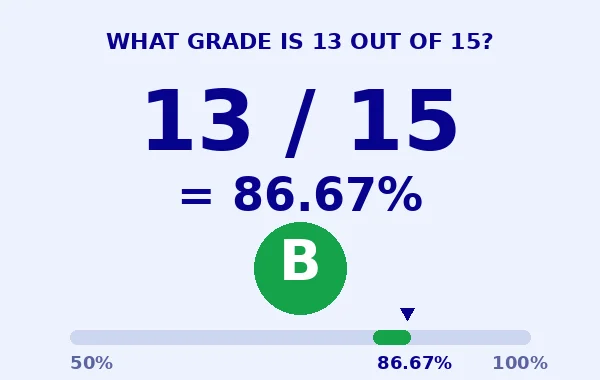
The short answer: 13/15 is 86.67%, which is a B on the plus/minus grading scale used across this site. On that scale, a B runs from 83% up to, but not including, 87%, so 86.67% sits inside the B band with only 0.33 of a percentage point to spare. It is a strong, solidly above-average result, yet it is not a B+, because the B+ band starts at 87% and this score stops just short of it.
Try it yourself: our test grade calculator works out any score out of 15, or any test size, in one click, with the full wrong-answer chart. For any percentage at all, use our letter grade calculator to see the letter grade, and check the 11 out of 15 grade if you want to compare a lower score on the same 15-question test.
What Is 13 Out of 15 on a Calculator?
13 out of 15 is 86.67%, which is a B, and you can check it in seconds with the calculator below. Enter 13 as the score and 15 as the total, press Calculate Grade, and the tool shows the percentage and the letter grade together. Change the numbers to any other score, such as 12 out of 15 or 14 out of 15, and it recalculates instantly using the same plus/minus scale used in the table further down this page.
13 Out of 15 Calculator
Enter any score and total to see the percentage and letter grade.
13 out of 15 = 86.67% — B
How Do You Calculate 13 Out of 15 as a Percentage?
You calculate 13 out of 15 as a percentage by dividing 13 by 15 and multiplying the answer by 100, which gives 86.67%. The formula is the same for every fraction: percentage equals correct answers divided by total questions, multiplied by 100. For this score, the working is 13 divided by 15 equals 0.8666 recurring, and 0.8666 recurring multiplied by 100 equals 86.666 recurring percent, which rounds to 86.67%.
The percentage is 86.67%, not 86.66%, because the decimal repeats forever and the third decimal place pushes the second one up. Dividing 13 by 15 gives 0.866666, with the 6 repeating without end, so the value to two decimal places is 86.67% by the normal rounding rule. Teachers and gradebooks usually show two decimal places for a score like this, which is why you will see 86.67% on a report, a calculator, and a grading chart rather than the unrounded 86.666%.
Each question on a 15-question test is worth 6.67% of the total, because 100% divided by 15 equals 6.666 recurring percent. That single fact explains the whole table in this guide: every extra correct answer adds about 6.67 points, so 12 out of 15 is 80%, 13 out of 15 is 86.67%, and 14 out of 15 is 93.33%. It also explains why a 15-question test feels unforgiving, since one missed question costs more than six percentage points, unlike a 100-question test where each question costs only 1%.
You can check the calculation with a quick mental shortcut, because 13 out of 15 is the same as 26 out of 30 and 39 out of 45, and each of those fractions also works out to 86.67%. Another shortcut is to start from 15 out of 15, which is 100%, and subtract two questions at 6.67% each, which takes 13.33% off the total and leaves 86.67%. Either route lands on the same answer, and either one is a useful way to confirm a calculator result instead of trusting it blindly.
What Letter Grade Is 13/15?
13/15 is a B, because 86.67% falls inside the B band of the plus/minus scale, which runs from 83% up to, but not including, 87%. The next band up, B+, starts at 87% and runs to just below 90%, so a score of 86.67% misses B+ by exactly 0.33 of a percentage point. That narrow gap is the whole story of this score: it is a comfortable B, and it is also the highest whole-number score out of 15 that is still a B, since the next score up jumps straight past B+.
The full plus/minus scale used on this site is A+ from 97 to 100%, A from 93 to just below 97%, A- from 90 to just below 93%, B+ from 87 to just below 90%, B from 83 to just below 87%, B- from 80 to just below 83%, C+ from 77 to just below 80%, C from 73 to just below 77%, C- from 70 to just below 73%, D+ from 67 to just below 70%, D from 63 to just below 67%, D- from 60 to just below 63%, and F below 60%. Read against that scale, 86.67% is unambiguously a B, with no room for a different reading unless your school uses a different scale altogether.
On a straight scale with no plus or minus, 13/15 is still a B, because a straight B runs from 80% to 89% and 86.67% sits near the top of it. That agreement matters, because it makes 13/15 a much less disputed score than 18/20, which is an A- on one scale and a plain A on the other. With 13/15, the two most common scales give the same letter, so a student, a parent, and a teacher can all call it a B without arguing about which scale applies.
Some schools use a different set of cutoffs, such as a B starting at 80% or 85% instead of 83%, and on those scales 13/15 is still a B, because 86.67% clears both of those lower floors. A school would need a B floor above 86.67%, which is very unusual, before this score stopped being a B. If your syllabus or gradebook shows a different letter for 86.67%, ask your teacher for the scale they use, because the percentage is fixed and only the band edges can move it.
As a GPA value, a B is worth 3.0 grade points on the standard 4.0 scale, which is the same value as any other B, whether it is 83% or 86.99%. That flat value is worth remembering, because it means the 0.33-point gap to B+ is worth 0.3 GPA points in a single course, from 3.0 up to 3.3, even though the percentage gap looks tiny. The letter, not the exact percentage, is what the GPA calculation reads, so the boundary matters far more than the distance from it.
What Is the Complete /15 Score Table?
The complete /15 score table below lists every score from 0 out of 15 to 15 out of 15, with the percentage, the letter grade on the plus/minus scale, and the GPA points for each one. Use it to find any score at a glance, or to see exactly where 13/15 sits among its neighbours, and bookmark this page if you grade or take 15-question quizzes regularly.
| Score | Percentage | Letter Grade | GPA Points |
|---|---|---|---|
| 15/15 | 100% | A+ | 4.0 |
| 14/15 | 93.33% | A | 4.0 |
| 13/15 | 86.67% | B | 3.0 |
| 12/15 | 80% | B- | 2.7 |
| 11/15 | 73.33% | C | 2.0 |
| 10/15 | 66.67% | D | 1.0 |
| 9/15 | 60% | D- | 0.7 |
| 8/15 | 53.33% | F | 0.0 |
| 7/15 | 46.67% | F | 0.0 |
| 6/15 | 40% | F | 0.0 |
| 5/15 | 33.33% | F | 0.0 |
| 4/15 | 26.67% | F | 0.0 |
| 3/15 | 20% | F | 0.0 |
| 2/15 | 13.33% | F | 0.0 |
| 1/15 | 6.67% | F | 0.0 |
| 0/15 | 0% | F | 0.0 |
Three things jump out of this table, and the first is that no whole-number score out of 15 earns a B+, a C+, a C-, a D+, or an A-. The /15 scale skips those bands entirely, because each question is worth 6.67% and the bands are only 3 or 4 points wide, so a single correct answer jumps straight over them. The second is the size of the jump from 13/15 to 14/15: one more correct answer moves you from a B at 86.67% to an A at 93.33%, skipping B+ and A- altogether, which is a 1.0 GPA-point swing from a single question.
The third thing the table shows is where the passing line falls, and it falls at 9 out of 15, which is exactly 60% and a D-. A score of 8 out of 15 is 53.33%, which is an F, so the difference between passing and failing a 15-question test is a single question, just as it is at the top of the table. That is the harsh arithmetic of short tests: with only 15 questions, every answer carries a large share of the grade, and there is no room for a run of careless mistakes.
Compare this table with the 11 out of 15 grade, which is 73.33% and a C, to see how quickly the letters change on a 15-question test. Two more correct answers take you from a C to a B, and one more after that takes you from a B to an A. On a 100-question test, the same two-question improvement would move the percentage by only 2 points and would rarely change the letter at all, which is why short quizzes reward accuracy so heavily.
Does 13/15 Round Up to a B+?
No, 13/15 does not round up to a B+ automatically, because 86.67% is a real score, not a rounded one, and the B+ band starts at 87%. Rounding would only help if a teacher or a gradebook rounded the percentage to the nearest whole number before applying the scale, and in that case 86.67% would round to 87% and would just reach the B+ floor. Whether that happens depends entirely on the rounding policy in your class, so never assume it, and never argue for it after the fact without checking the syllabus first.
Rounding usually happens, when it happens at all, at the end of a course, not on a single quiz. A teacher who rounds final course grades might record a final average of 86.67% as 87% and award a B+, especially if the student has shown steady improvement or has completed every assignment. A teacher who rounds a single 13/15 quiz to a B+ is much rarer, because the quiz itself is already a clean, exact result, and changing its letter would mean recording a different grade from the one the numbers produce.
Rounding does not happen when the gradebook applies the scale automatically, which is how most learning management systems work. Canvas, Google Classroom, and similar systems compare the exact percentage, 86.67%, with the band edges and return a B, without any rounding step in between. It also does not happen when the syllabus states that grades are recorded exactly as earned, or when the teacher uses a scale with no rounding rule at all. In those classrooms, 86.67% is a B on the day it is earned and a B at the end of the term, and the 0.33-point gap stays a gap.
Half points change the rounding question completely, because a score of 13.5 out of 15 is 90%, which is an A-, not a B+. If your teacher gives half credit for a partially correct answer, a 13/15 with one half-point answer becomes 13.5/15, and that half point is worth far more than any rounding rule, since it moves the score by 3.33 percentage points. The lesson is practical: if half credit is available, it is worth asking for it on a question you partly answered, because it can move the letter by two bands at once.
The honest way to think about the 0.33-point gap is that it is smaller than the value of a single question, and smaller than the value of a half point, so it is not a gap you can close by re-marking one answer. You would need a policy decision, a rounding rule, or an extra half point to cross it, and none of those is in your control on the day of the test. What is in your control is the next test: one more correct answer on the next 15-question quiz takes you to 14/15, which is 93.33% and an A, so the fastest route past B+ is not rounding, it is one more right answer.
Is 13/15 a Good Grade?
Yes, 13/15 is a good grade, because it means you answered 86.67% of the questions correctly, you earned a B, and you scored 3.0 GPA points out of a possible 4.0. You missed only two questions out of fifteen, which is a small number of mistakes on any test, and you finished well above the usual pass mark of 60% and well above the C range where most class averages sit. By the numbers alone, there is nothing to be unhappy about in a 13/15.
The context that makes 13/15 look even better is the class average, because most classes average somewhere in the 70s on a test, which is a C range. A score of 86.67% is roughly 10 to 15 points above a typical average, which usually puts it in the top quarter of a classroom, and on a hard test where the average was 10 out of 15, it would be an outstanding result. A grade is always partly relative, and a B that beats the average by a wide margin is a stronger result than the same letter on an easy test where everyone scored highly.
The one honest caveat is that good depends on what the test was, and a 13/15 on a take-home quiz where most of the class scored 15 out of 15 is merely solid rather than excellent. It also depends on your own goals: a student aiming for straight As will see a B as a grade to improve on, while a student aiming to pass a difficult subject will see the same B as a success. Both readings are fair, because a grade is a measurement, and what counts as good is the target you set against that measurement.
For parents and teachers, the useful question about a 13/15 is not whether it is good in the abstract, but what the two missed questions were. If both misses were careless errors on questions the student knew, the fix is checking work rather than studying more. If both misses were on the same topic, the fix is to revisit that topic before the next test. A B with a clear pattern in its mistakes is more useful than an A with no pattern, because it tells you exactly what to work on next.
What Does 13/15 Do to Your GPA?
A 13/15 contributes 3.0 grade points if it is the grade for a whole course, because a B is worth 3.0 points on the standard 4.0 GPA scale. As a single quiz inside a course, it contributes far less, because the GPA reads the final course letter, not each quiz, and a single quiz is only one part of that final letter. The difference matters: one B on one quiz will rarely change a final course grade by itself, while a B as a final course grade moves the GPA by a measurable amount.
Take five 3-credit courses as an example, with four of them at A-, worth 3.7 points each, and the fifth at B, worth 3.0 points. The GPA is 3.7 plus 3.7 plus 3.7 plus 3.7 plus 3.0, which is 17.8, divided by 5, which is 3.56. If that fifth course had been a B+ at 3.3 points instead of a B, the total would be 18.1 divided by 5, which is 3.62, so the gap between a B and a B+ in one course out of five is 0.06 GPA points. That is the real cost of the 0.33-point gap to B+ in GPA terms.
The bigger lever is always the number of A-range grades, not whether one of them is a B or a B+. Five courses at B give a 3.0 GPA, five courses at A give a 4.0 GPA, and a mix of the two lands somewhere in between, weighted by credits. If you want to run your own numbers, our GPA calculator averages any set of letter grades, and our cumulative GPA calculator shows how this term folds into your overall GPA. For the benchmarks, such as what counts as a good GPA in high school versus college, see our guide to what is a good GPA.
One more GPA point is worth making plainly: a B is never a GPA disaster, and a single B in a transcript full of As is a normal, healthy pattern. Colleges and employers read the whole transcript, not one letter, and a 3.5 GPA with a mix of As and Bs is a strong result by any standard. The score to worry about is not a B, it is a pattern of Cs and Ds, because those are the grades that pull a GPA down by a full point at a time.
Worked Examples: What Does a 13/15 Quiz Do to Your Class Grade?
A 13/15 quiz changes your class grade only as far as its weight allows, because a quiz contributes its percentage times its weight to the final grade. The formula is simple: multiply the quiz percentage by the quiz weight, multiply the rest of your grade by its weight, and add the two together. The three examples below use the same 86.67% quiz at three different weights, so you can see how the same result can lift a class grade by a little, or by a lot, depending on how much the quiz counts.
Example 1: a 13/15 quiz worth 10% of your final grade, with the rest of your coursework averaging 80%. The quiz contributes 86.67% multiplied by 0.10, which is 8.67 points, and the rest contributes 80% multiplied by 0.90, which is 72 points, so your final grade is 8.67 plus 72, which is 80.67%, a B-. One strong quiz at 86.67% lifted an 80% average by only 0.67 points, because a 10% weight gives it very little room to move the total.
Example 2: the same 13/15 quiz, now worth 25% of your final grade, with the rest of your coursework averaging 92%. The quiz contributes 86.67% multiplied by 0.25, which is 21.67 points, and the rest contributes 92% multiplied by 0.75, which is 69 points, so your final grade is 21.67 plus 69, which is 90.67%, an A-. Here the same quiz pulled a 92% average down by 1.33 points, because a heavier quiz has more power, and a B is below the 92% average it is being added to.
Example 3: recovering from a bad quiz with a 13/15, where the first quiz was 10 out of 15, which is 66.67% and a D, and the second quiz was 13 out of 15, which is 86.67% and a B. If both quizzes count equally, the average is 66.67 plus 86.67, which is 153.34, divided by 2, which is 76.67%, a C+. The strong second quiz pulled the average up 10 points from the first quiz, but it did not erase the first quiz, and you would need a 93.33% on the next quiz to average 80% across the three.
To find exactly what you need on the next test to hit a target grade, use our final grade calculator, which works backwards from your target to the score you need. For the full picture of how many misses each grade allows on every test size, see our guide to how many questions you can miss and still pass, and for the weighting rules behind these examples, see our guide to understanding grade weighting.
How Does 13/15 Compare With the Scores Around It?
13/15 compares with its neighbours in a way that shows how steep the /15 scale is, because one question in either direction changes the letter by a full band or more. The score below it, 12/15, is 80% and a B-, worth 2.7 GPA points, so one fewer correct answer costs 6.67 percentage points and 0.3 GPA points. The score above it, 14/15, is 93.33% and an A, worth 4.0 GPA points, so one more correct answer gains 6.67 percentage points and a full 1.0 GPA point, skipping two letter bands on the way.
The wider comparison is with 11 out of 15, which is 73.33% and a C, worth 2.0 GPA points, so the gap from 11/15 to 13/15 is two questions, 13.33 percentage points, and a full GPA point. That is the same gap, in question terms, as the gap from 13/15 to 15/15, which is also two questions, but the letter gap there is only from a B to an A+, worth 1.0 GPA point as well. The scale is steep everywhere on a 15-question test, and there is no part of it where a single question is cheap.
Compare 13/15 with 13 out of 20, which is 65% and a D, to see why the total matters as much as the number correct. The same 13 correct answers are a B on a 15-question test and a D on a 20-question test, because the percentage is what the scale reads, not the raw count. Students who compare raw scores across different test sizes are comparing different things, and the only fair comparison is the percentage, which is why this guide always gives the percentage first and the letter second.
Frequently Asked Questions
What grade is 13 out of 15?
13 out of 15 is 86.67%, which is a B on the standard plus/minus scale, where a B runs from 83% to just below 87%. It is worth 3.0 GPA points, and it is the same letter on a straight 90/80/70/60 scale, where a B runs from 80% to 89%. You get the percentage by dividing 13 by 15 and multiplying by 100, which gives 86.666 recurring percent, rounded to 86.67%.
Is 13 out of 15 a B or B+?
13 out of 15 is a B, not a B+, because 86.67% is 0.33 of a percentage point below the B+ floor of 87%. A B+ starts at 87% and runs to just below 90%, so this score stops just short of it, and no whole-number score out of 15 falls inside the B+ band at all. The next score up, 14 out of 15, jumps straight to 93.33%, which is an A.
What is 13/15 as a percentage?
13/15 as a percentage is 86.67%, calculated as 13 divided by 15, multiplied by 100. The division gives 0.8666 recurring, so the percentage is 86.666 recurring percent, which rounds to 86.67% to two decimal places. Each question on a 15-question test is worth 6.67%, so two missed questions cost 13.33% and leave 86.67%.
Is 13/15 a good grade?
Yes, 13/15 is a good grade, because 86.67% is a B, it is well above the usual pass mark of 60%, and it is usually 10 to 15 points above a typical class average in the 70s. You missed only two questions out of fifteen, and you earned 3.0 GPA points. It is a strong result on a hard test, and a solid one on an easy test where most students scored higher.
Does 13/15 round up to a B+?
No, 13/15 does not round up to a B+ automatically, because the exact score is 86.67% and the B+ band starts at 87%. It would only become a B+ if a teacher or gradebook rounded the final percentage to the nearest whole number first, which would give 87%, and that rounding usually applies to final course grades, not to a single quiz. Check your syllabus, because most gradebooks apply the scale to the exact percentage.
What is 13/15 as a GPA?
On the standard 4.0 scale, 13/15 is worth 3.0 grade points, which is the value of a B, because the GPA reads the letter, not the exact percentage. A B+ would be worth 3.3 points, so the 0.33-point gap to B+ is worth 0.3 GPA points in a single course, or about 0.06 GPA points across five equal courses. Use our GPA calculator to work out how a B changes your own overall GPA.
The One-Paragraph Version
13/15 is 86.67%, which is a B worth 3.0 GPA points on the plus/minus scale, and a B on a straight scale too, because the B band covers 83% to just below 87% on the first scale and 80% to 89% on the second. It misses B+ by only 0.33 of a percentage point, and no whole-number score out of 15 lands in the B+ band, since the next score up is 14/15 at 93.33%, which is an A. Each question on a 15-question test is worth 6.67%, so every answer matters, and a 13/15 is a good, above-average grade by any measure. If you want the same answer for any other score, our letter grade calculator converts any percentage or points score to a letter grade, and our test grade calculator builds the full chart for any test size.