

Australian Grades Explained: HD, D, C, P, WAM and the 7-Point Scale
Short answer: Australian universities grade with five bands — HD, D, C, P and F — plus a WAM (Weighted Average Mark) and a 7-point GPA. There is no A, B or C+ here, and no 4.0 GPA. A mark of 80% is a top grade in Australia, where the same 80% is a B− in the United States. This is the Australian grading system explained in plain words: what each band means, why High Distinction starts at 85 at some universities and 80 at others, how WAM and the 7-point GPA are worked out, what WAM you need for honours, and how Australian grades compare with US grades.
If you already know your marks and just want the number, our WAM Calculator works out your WAM and your 7-point GPA from your subjects and credit points. This post is the meaning behind those numbers — what each grade says about your work, and what it opens up for you.
What Do HD, D, C and P Mean?
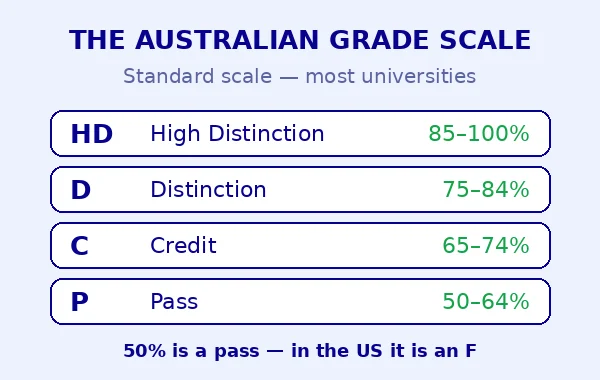
HD means High Distinction, D means Distinction, C means Credit, P means Pass, and F means Fail. These five bands are the whole Australian university grading scale, and they work the same way at almost every university in the country. Your mark in each subject falls into one band, and that band is the grade on your transcript — there is no plus or minus version of any band, and no A or B anywhere in the system.
The standard bands, used by most Australian universities, are shown in the table below. Each band also carries a grade point on the 7-point GPA scale, which is explained further down this page. The pass line is 50%: anything from 50% up is a pass of some kind, and anything below 50% is a fail.
| Grade | What it stands for | Mark range | 7-point GPA | What it means |
|---|---|---|---|---|
| HD | High Distinction | 85–100% | 7 | Outstanding work — the top band, hard to reach |
| D | Distinction | 75–84% | 6 | Excellent work, clearly above the standard |
| C | Credit | 65–74% | 5 | Good work, solidly above a pass |
| P | Pass | 50–64% | 4 | Satisfactory — you met the requirements |
| F | Fail | Below 50% | 0 | Did not meet the requirements |
Two things about this table surprise students from other countries. First, the bands are wide: a Pass covers fifteen marks (50 to 64), while a High Distinction covers fifteen marks too (85 to 100). Second, the top of the scale is genuinely hard to reach — an 85% is not “a good mark”, it is the best grade the system gives, and most subjects award very few HDs. That is why Australian employers and universities read the band, not just the number: a Distinction average already says a lot about a student.
Why Is HD 85 at Some Universities and 80 at Others?
Because Australia has no single national grading law, so a few universities set their own thresholds — and the most common difference is the HD line. Most universities use the standard scale above, with HD starting at 85%. But Monash University and the Australian National University (ANU) start HD at 80%, and they shift the other bands down with it. The same mark can therefore be a different grade at different universities, which is the single most confusing thing about the Australian system.
| Grade | Standard scale (most universities) | Monash / ANU scale |
|---|---|---|
| HD | 85–100% | 80–100% |
| D | 75–84% | 70–79% |
| C | 65–74% | 60–69% |
| P | 50–64% | 50–59% |
| F | Below 50% | Below 50% |
Take a mark of 82%. At the University of New South Wales or the University of Queensland, 82% is a Distinction — a very good grade, but not the top one. At Monash, the same 82% is a High Distinction. Neither university is wrong; they simply draw the line in a different place, and your transcript always shows the grade your own university awarded. Anyone comparing grades across universities — an employer, a scholarship panel, a university overseas — has to know which scale produced them, which is why your university’s name matters as much as the letter on the page.
The University of Melbourne is a special case worth knowing about. It does not use HD, D, C and P at all for its graded bands. Instead it uses H1 (80–100%), H2A (75–79%), H2B (70–74%), H3 (65–69%), P (50–64%) and N for a fail. The names come from the honours classification system, and they map onto the same 7-point GPA scale — H1 is worth 7 points, just like an HD. If you see H1 on a Melbourne transcript, it is the top grade, not a first-year subject code.
What Is WAM and How Is It Different From GPA?
WAM is the Weighted Average Mark: the average of your raw percentage marks, weighted by how many credit points each subject is worth. It is the headline number at the big WAM universities — UNSW, UTS, Macquarie, Melbourne and Monash among them — and it is the number honours places and scholarships are usually decided on. The formula is simple: multiply each subject’s mark by its credit points, add those up, and divide by the total credit points.
WAM = (mark × credit points) added up for every subject ÷ total credit points. Here is a worked example with four subjects. The marks are 82 (6 credit points), 76 (6 credit points), 91 (12 credit points) and 68 (6 credit points). Multiply each mark by its credit points: 82 × 6 = 492, 76 × 6 = 456, 91 × 12 = 1,092, and 68 × 6 = 408. Add them up: 492 + 456 + 1,092 + 408 = 2,448. The total credit points are 6 + 6 + 12 + 6 = 30. Divide: 2,448 ÷ 30 = 81.6. The WAM is 81.6, which sits in the Distinction band on the standard scale.
Three details of the WAM rules catch students out. First, failed subjects count: a failed mark is included at the mark you actually got, so a 42% pulls the WAM down just as surely as an 82% pulls it up. Second, credit points are usually 6 per subject, but the University of Melbourne uses 12.5, so one Melbourne subject carries more weight than one subject elsewhere. Third, some universities weight years differently — Monash, for example, weights first-year subjects at half value in some WAM calculations — so always check your own university’s handbook for the exact rule before quoting a number.
So what is the difference between WAM and GPA? WAM averages your raw marks; GPA averages your grade bands. WAM keeps every mark exactly as it was — an 84 and a 76 are five marks apart, and the WAM shows that. GPA first turns each mark into a band point (HD = 7, D = 6, C = 5, P = 4) and then averages those points, so the 84 and the 76 both become a 6 and the five-mark gap disappears. That is why two students can have the same GPA and different WAMs, and why competitive programs increasingly ask for the WAM: it is the more precise number.
| WAM | GPA (7-point) | |
|---|---|---|
| What it averages | Raw percentage marks | Grade band points (HD = 7 … P = 4) |
| Range | 0–100 | 0–7 |
| Precision | Exact — every mark counts | Banded — marks inside one band count the same |
| Used most for | Honours, scholarships, transfers | Exchange, overseas applications, some employers |
Here is the proof that the two numbers can disagree. Student A scores 84 and 76: both are Distinctions worth 6 points, so her GPA is 6.0, and her WAM is 80. Student B scores 76 and 76: also two Distinctions, so her GPA is also 6.0 — but her WAM is 76. Same GPA, four WAM points apart. If a scholarship cut-off is a WAM of 80, Student A qualifies and Student B does not, even though their GPAs are identical. That gap is the whole reason Australia keeps both numbers.
How Does the 7-Point GPA Work?
The 7-point GPA turns each grade band into a number — HD is 7, D is 6, C is 5, P is 4, F is 0 — and then averages those numbers, weighted by credit points. It is the scale most Australian universities report, and it is completely different from the American 4.0 GPA, where an A is worth 4.0. An Australian GPA of 6.0 is a strong Distinction average, not a failing grade — a mistake overseas readers make often, so it is worth stating plainly.
The formula is: GPA = (grade points × credit points) added up for every subject ÷ total credit points. Take the same four subjects as the WAM example: 82% (Distinction, 6 points, 6 credit points), 76% (Distinction, 6 points, 6 credit points), 91% (High Distinction, 7 points, 12 credit points) and 68% (Credit, 5 points, 6 credit points). Multiply points by credit points: 6 × 6 = 36, 6 × 6 = 36, 7 × 12 = 84, and 5 × 6 = 30. Add them up: 36 + 36 + 84 + 30 = 186. Divide by the total credit points, 30: 186 ÷ 30 = 6.2. The GPA is 6.2 out of 7 — a Distinction average, sitting between a Credit (5) and a High Distinction (7).
Some Australian universities also report a 4-point GPA alongside the 7-point one, and the mapping varies — which is why converting an Australian GPA to an American 4.0 GPA has no official formula. The rough rule people quote is WAM ÷ 25: a WAM of 75 works out to about 3.0 on the American scale, and a WAM of 81.6 works out to about 3.3. Treat that as an estimate only. If you are applying overseas, ask the university you are applying to how it reads Australian grades, because it will have its own conversion table and will not accept a self-converted number.
What WAM Do You Need for Honours?
For First Class Honours you typically need a WAM of 80 or above, but the exact cut-off is set by your faculty, not by a national rule. Australian honours degrees — usually a one-year postgraduate qualification, or an embedded fourth year of your degree — are classified by WAM, and the bands below are the typical thresholds published by universities. Treat them as a guide, not a promise: faculties differ on the cut-offs, on which subjects count (often only later-year or thesis subjects), and on how heavily the thesis mark is weighted.
| Honours class | Typical WAM | What it usually opens up |
|---|---|---|
| H1 — First Class Honours | 80+ | PhD entry, competitive scholarships |
| H2A — Second Class, Division A | 75–79 | Research master’s, some PhD programs |
| H2B — Second Class, Division B | 70–74 | Coursework master’s, graduate roles |
| H3 — Third Class Honours | 65–69 | Honours degree awarded, limited research entry |
Two practical points follow from this table. First, honours is judged on WAM, not GPA, in most programs — the raw marks matter, so a student sitting at 79.4 needs one more strong subject, not a better band. Second, the thesis or research project often carries a heavy weight in the honours WAM itself, sometimes as much as half the year’s credit points, so a strong thesis can lift a borderline WAM over the line — and a weak one can pull it under. If honours is your goal, the number to watch from your second year onward is your WAM, and the WAM Calculator will tell you where you stand and what you need from your remaining subjects.
How Do Australian Grades Compare With US Grades?
They do not line up at all — the same percentage means a different thing in each system, and a US calculator will give an Australian student a wrong answer. The clearest proof is 80%: in Australia it is a Distinction or a High Distinction, one of the top grades in the country; in the United States it is a B−, a below-average grade worth 2.7 grade points. The two systems use the same numbers and mean different things by them, because the Australian scale is built around a 50% pass line and a hard-to-reach top, while the US scale is built around a 60% pass line and a 90% A.
| Percentage | Australia (standard scale) | United States |
|---|---|---|
| 90% | High Distinction (7 points) | A− (3.7 points) |
| 85% | High Distinction (7 points) | B (3.0 points) |
| 80% | Distinction (6 points) | B− (2.7 points) |
| 75% | Distinction (6 points) | C (2.0 points) |
| 70% | Credit (5 points) | C− (1.7 points) |
| 60% | Pass (4 points) | D− (0.7 points) |
| 50% | Pass (4 points) | F (0.0 points) |
The most dangerous row in that table is the last one. A 50% mark in Australia is a pass — not a good pass, but a pass, worth 4 grade points. The same 50% in the United States is an F, worth nothing. Any student who feeds Australian marks into a US tool — for example, our own Letter Grade Calculator or GPA Calculator, which are built on the US scale — will get a letter grade and a GPA that badly understate their results. That is exactly why this site has a separate WAM Calculator for Australia, and why the UK has its own Degree Classification Calculator instead of a GPA: each country grades differently, so each country needs its own tool.
What Is a Good WAM in Australia?
A WAM above 65 is a Credit average and a good result; above 75 is a strong Distinction average; 80 or above is First Class Honours territory. Those three lines are the Australian grading system explained in its simplest form: bands for meaning, WAM for precision. A WAM in the 50s means you are passing but not much more, and it is worth asking what is holding the marks down before the next semester. A WAM in the 60s is a solid, respectable average that keeps most doors open. A WAM in the 70s is strong — it qualifies you for most honours programs and competitive master’s degrees. A WAM of 80 or above puts you in the top group of your cohort, and it is the number scholarships and PhD programs ask for first.
Context matters as much as the number itself. A WAM of 72 in a notoriously hard-marking subject like first-year engineering or medicine is a better result than the same WAM in a subject where the class average is 78. Employers in Australia usually ask for your WAM or GPA band rather than a single number, and they know which universities mark hard. And remember that your WAM is a moving average: one bad semester early on can be repaired, because every new subject you pass well pulls the average up — slowly at first, faster as your total credit points grow. If you want to know exactly what you need from your remaining subjects, the WAM Calculator has a target solver built in for that question.
Australian Grading System Explained: Frequently Asked Questions
What is a good WAM in Australia?
A WAM above 65 is a Credit average and a good result. Above 75 is a strong Distinction average, and 80 or above is First Class Honours territory. Most honours programs ask for a WAM around 70 to enter, and competitive scholarships and PhD programs usually look for 80 or above.
Is 70% a good grade in Australia?
Yes, 70% is a solid grade in Australia. On the standard scale it is a Credit, worth 5 grade points; at Monash or ANU, where the bands sit lower, it is a Distinction, worth 6 points. Either way it is twenty marks above the pass line and a result most students would be happy with.
What does HD mean in Australian grades?
HD means High Distinction, the top grade in the Australian university system. It usually starts at 85%, although Monash University and the Australian National University start it at 80%. An HD is worth 7 points on the 7-point GPA scale.
Is WAM or GPA more important in Australia?
It depends on who is asking. WAM is more important for honours entry, scholarships and transfers inside Australia, because it keeps your exact marks. GPA matters more for exchange programs and overseas applications, where the receiving university expects a GPA-style number. Both appear on your academic record, so neither can be ignored.
Can I convert my Australian GPA to a US 4.0 GPA?
There is no official conversion formula. The rough estimate people quote is WAM divided by 25 — a WAM of 75 works out to about 3.0 on the American scale. Do not rely on that for an application: ask the university you are applying to, because it will have its own conversion table.
What WAM do I need for First Class Honours?
Typically a WAM of 80 or above, although the exact cut-off is set by your faculty and some programs weigh the thesis heavily. Second Class Upper (H2A) is usually 75–79, Second Class Lower (H2B) is 70–74, and Third Class (H3) is 65–69.

