
UK Degree Classification Explained: First, 2:1, 2:2 and Third — What They Mean
UK degree classification is the system British universities use to grade an honours degree, and it works very differently from the American GPA scale. Instead of a number out of 4.0, you graduate with a class: a First, a 2:1, a 2:2 or a Third. This guide explains what each class means, the percentage you need for each one, what happens if you land just below a boundary, how master’s degrees are graded, and what employers actually ask for.
The short version is simple. A First starts at 70%, a 2:1 at 60%, a 2:2 at 50% and a Third at 40%. That is the whole scale, and the rest of this guide is about what those numbers mean in practice — because in the UK, 70% is not a B minus. It is the top grade a university can give you.

UK Degree Classification Explained: The Four Classes at a Glance
The UK degree classification system has four honours classes, and every UK university uses the same four bands. The table below shows each class, the name students actually use for it, and the overall percentage it starts at.
| Class | What students call it | Overall mark | What it means |
|---|---|---|---|
| First Class Honours | A First, a 1st | 70% and above | Exceptional work — the top grade |
| Upper Second Class Honours | A 2:1, a two-one | 60–69% | Strong work — the most common class |
| Lower Second Class Honours | A 2:2, a two-two | 50–59% | A solid honours degree |
| Third Class Honours | A Third, a 3rd | 40–49% | The lowest honours class |
Below 40% you usually fail the degree, although some universities award an Ordinary degree — a degree without honours — to students who finish below the Third Class threshold. The exact rules for that vary, so your own university’s regulations are the final word.
Two things catch international students out straight away. First, there is no GPA in the UK system at all: your whole degree comes down to one class. Second, the pass mark at undergraduate level is 40%, not 50% — a mark of 45% is a pass at bachelor’s level, even though the same mark would fail a master’s degree, as explained further down this page.
What Is a First Class Degree?
A First is the highest class a UK university can award, and it starts at 70%. It is given for work that is original, well argued and consistently excellent across the degree, not just for getting most of the answers right.
That is why a First is rarer than an American A. In the United States, an A often starts at 90% or 93%, and a strong student can collect them regularly. In the UK, markers treat 70% as the line for outstanding work, and marks above 80% are given sparingly — usually only for work the marker thinks could be published. Education sites estimate that roughly a quarter to a third of UK graduates achieve a First, which makes it genuinely selective.
A First opens the most doors. It is usually expected for funded PhD places and academic jobs, and it is the class the most competitive graduate schemes prefer. That said, a First on its own does not guarantee a job — employers still weigh work experience, interviews and skills tests, and a First with no experience can lose out to a 2:1 with a strong CV.
What Is a 2:1 Degree?
A 2:1 is an Upper Second Class Honours degree, awarded for an overall mark of 60–69%. It is the most common class in the UK — education sites estimate that roughly half of all graduates leave with a 2:1 — and it is the class most employers and postgraduate courses use as their benchmark.
A 2:1 shows sound understanding, good use of evidence and some critical thinking, even if the argument is not always original or consistent. In plain terms, it tells an employer you can handle demanding work reliably, which is why so many graduate schemes, law firms, banks, consultancies and the Civil Service Fast Stream list a 2:1 as their minimum entry requirement.
If you are aiming at a competitive job or a master’s degree, a 2:1 is the class to target. Most taught master’s courses ask for a 2:1, and the best-funded PhD routes usually want a First or a strong 2:1 plus a master’s. A 2:1 is a good degree by any measure — it is the standard the system itself is built around.
What Is a 2:2 Degree? Is It a Bad Degree?
A 2:2 is a Lower Second Class Honours degree, awarded for an overall mark of 50–59%. It is not a bad degree: it is a full honours degree, earned by passing every year of a demanding course, and it still opens the door to many employers and postgraduate courses.
The honest picture is that a 2:2 does close some doors. The most competitive graduate schemes ask for a 2:1, and some master’s courses will ask you to show extra evidence — relevant work experience, a strong dissertation or a good final year — before they accept you. But many large employers accept 2:2 graduates onto their schemes, including BAE Systems, the Civil Service, Enterprise Rent-a-Car, EY, Network Rail, the NHS and Tesco.
What matters most with a 2:2 is what sits next to it. Recruiters increasingly value work experience and transferable skills over the class alone, so a 2:2 with a placement year, part-time work or volunteering behind it can beat a bare 2:1. Put the 2:2 on your CV honestly — hiding it looks worse than the grade itself — and let the rest of your application do the talking.
What Is a Third Class Degree?
A Third is the lowest honours class, awarded for an overall mark of 40–49%. It is still an honours degree, and it still proves you completed a full university course, but it limits your options more than any other class.
Most competitive graduate schemes and master’s courses will not accept a Third on its own. That does not mean the degree is useless: many employers outside the big graduate schemes do not set a class minimum at all, and a Third plus solid work experience can still build a good career. If postgraduate study is the goal, the usual route is to strengthen the application first — a year of relevant work, or a postgraduate certificate or diploma — rather than applying straight away.
If you are heading for a Third, the best move is to check your university’s borderline rules now, because a mark of 48% or 49% may be reviewed by the exam board, as the borderline section below explains.
Why Is 70% a First? UK Marking vs US Grades
The question every international student asks is why 70% — a B minus in the United States — is the top grade in the UK. The answer is that the two systems are built on different ideas of what a percentage means.
In the US, a percentage usually measures how many answers you got right: 90% right is an A. In the UK, a percentage measures the quality of your work against a standard of excellence, and the scale is used much more sparingly. A mark in the 50s means competent work, a mark in the 60s means strong work, and a mark of 70% or above means the work is exceptional — original, critical and well argued. Marks above 80% are rare because they are reserved for work the marker considers publishable or near-professional.
That is also why a mark of 50% in your first year is nothing to panic about. UK universities themselves say that anything over 50% in the first year is a good mark and a solid base to build on, because first-year marks usually do not count towards your final class at all.
| UK class | Typical mark | Rough US equivalent |
|---|---|---|
| First | 70% and above | About an A |
| 2:1 | 60–69% | About an A− or B+ |
| 2:2 | 50–59% | About a B or B− |
| Third | 40–49% | About a C |
The table above is a rough guide only. There is no official conversion between UK classes and the American GPA scale, and every university and employer uses its own table. If you are applying abroad, ask the receiving university which conversion it uses rather than guessing from a table like this one. For the American side of the comparison, see how to calculate your GPA.
How Is Your Degree Class Worked Out?
Your class is worked out from a credit-weighted average of your module marks, with each year of study weighted differently. The calculation has two steps: first each year’s average is weighted by the credits of its modules, then the years are combined using your university’s year weighting.
The year weighting is where universities differ most. Your first year usually counts for 0% — it decides whether you progress, not your final class. The second and third years carry the weight, and the most common splits are 40:60, 33:67, 50:50, or final-year-only. Some universities also discount your worst module, and resit marks are usually capped at the pass mark of 40%.
Here is one worked example on the common 40:60 split. A student averages 62.5% in Year 2 and 64.0% in Year 3. The calculation is 0.4 × 62.5 = 25.0, plus 0.6 × 64.0 = 38.4, giving 63.4% overall — an Upper Second, or 2:1, sitting 6.6 points below the First boundary. To work out your own class, use the Degree Classification Calculator, which lets you enter your module marks and credits and try each year-weighting preset.
What Happens If You Are Just Below a Boundary? Borderline Rules
Landing just below a boundary is the most stressful place in the UK system, and it is also the place where the rules are most often misunderstood. A mark of 68% or 69% is not automatically rounded up to a First, and a mark of 59% is not automatically a 2:1.
Most universities treat students within about 2 percentage points below a boundary as borderline cases. The exam board then looks at your profile of marks before deciding: how many of your credits sit in the higher band, what your dissertation mark was, and whether your marks improved over the degree. A student on 68.8% whose final-year modules are mostly in the First band has a real chance of being lifted; a student on 68.1% whose marks are flat across the 60s usually does not.
Three things decide a borderline case in practice. First, your university’s own regulations — some round 69.5% up, others never round at all. Second, your dissertation, which is often the single biggest module and the one the board looks at first. Third, your trajectory: a student who rose from 58% to 72% looks very different from one who fell from 72% to 58%. If you are near a boundary, read your programme handbook’s borderline section before you assume anything.
How Are Master’s Degrees Graded? Distinction, Merit and Pass
Taught master’s degrees in the UK — MA, MSc, MBA and LLM courses — are not classified like undergraduate degrees. Instead of First, 2:1, 2:2 and Third, you receive one of three grades: Distinction, Merit or Pass.
| Master’s grade | Typical mark | Rough undergraduate equivalent |
|---|---|---|
| Distinction | 70% and above | About a First |
| Merit | 60–69% | About a 2:1 |
| Pass | 50–59% | About a 2:2 |
| Fail | Below 50% | — |
Two rules catch students out. First, the pass mark at master’s level is 50%, not 40% — a mark of 45% is a fail at master’s level even though it would pass an undergraduate module. Second, the dissertation often has its own threshold: many universities require a dissertation mark of 70%, or close to it, for an overall Distinction, even if your module average is above 70%. The dissertation is usually worth 60 of the 180 credits on a standard taught master’s, so it carries a third of the whole degree.
A Distinction at master’s level is broadly comparable in prestige to a First at undergraduate level, and a Merit to a 2:1, but the two systems are not formally interchangeable — they are assessed on separate criteria by separate exam boards. Four-year integrated master’s degrees are the exception: they combine undergraduate and postgraduate study and follow the undergraduate First, 2:1, 2:2 and Third classification instead.
What Do Employers and Universities Actually Ask For?
For most jobs, the class is a filter, not the whole decision. The most competitive graduate schemes — in law, banking, consulting and the Civil Service Fast Stream — commonly ask for a 2:1 as a minimum, and a First is preferred for the most selective ones. Below that level, most employers look at the whole application: skills, experience, interviews and tests matter at least as much as the class.
For further study, the bar is similar. Most taught master’s courses ask for a 2:1, although some accept a 2:2 with relevant experience or a strong final year. PhD funding is the strictest route of all: it usually expects a First, or a strong 2:1 plus a master’s degree, because funded places are few and competition is fierce.
The practical advice follows from that. If you are aiming at a competitive scheme or a funded PhD, protect the 2:1 — and the First if you can reach it. If you are heading for a 2:2 or a Third, put your energy into the things that sit beside the grade: a placement year, part-time work in your field, volunteering, and a dissertation you can talk about in an interview. Employers are moving away from treating a First or a 2:1 as the be-all and end-all, and a strong record of work is now the best answer to a weaker class.
How Does the UK System Compare With Australia and Canada?
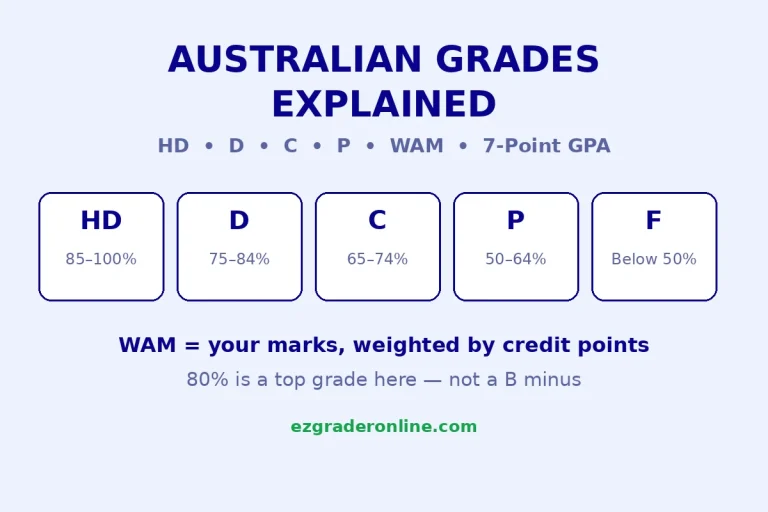
The UK is not the only country that grades differently from the United States, and the contrasts are useful if you are choosing where to study. Australia grades each subject with a band — High Distinction, Distinction, Credit or Pass — and combines them into a WAM, a weighted average mark, rather than a single class; see Australian grades explained for the full picture.
Canada has no single national scale at all: each province and university uses its own mix of percentages, letters and GPA scales, from 4.0 to 4.33 to 9-point and 12-point systems. The Canada GPA Calculator handles those scales, and a full explainer of the Canadian system is coming next in this series.
The UK’s system is the most compressed of the three: your whole degree becomes one of four words. That makes the class easy for employers to read, and it makes the borderline zones — the 68s and 69s, the 58s and 59s — matter more than they would anywhere else, because one point can change the word on your degree certificate.
UK Degree Classification Explained: Frequently Asked Questions
What percentage do you need for a First in the UK?
You need an overall mark of 70% or above for a First Class Honours degree. The overall mark is a credit-weighted average of your module marks, with the final year usually carrying the most weight. A First is the top class, and marks above 80% are rare because they are reserved for exceptional work.
Is a 2:1 a good degree?
Yes. A 2:1 is a good degree and the class most UK graduates achieve — roughly half of all graduates leave with one. It is the standard minimum for most competitive graduate schemes and most taught master’s courses, and it shows an employer you can handle demanding work reliably.
Is a 2:2 a bad degree?
No. A 2:2 is a full honours degree for an overall mark of 50–59%, and it is still a real achievement. Some competitive graduate schemes and master’s courses ask for a 2:1, but many large employers accept 2:2 graduates, including BAE Systems, EY, the NHS and Tesco, especially when the degree is backed by work experience.
Can you get a job with a Third class degree?
Yes, although a Third limits your options. Most competitive graduate schemes and master’s courses will not accept a Third on its own, but many employers outside those schemes set no class minimum at all. Relevant work experience, a placement year or a further qualification are the usual ways to strengthen a Third.
What is a Distinction at master’s level in the UK?
A Distinction is the top grade for a taught master’s degree, usually awarded for an overall mark of 70% or above. Below it come Merit (60–69%) and Pass (50–59%). The pass mark at master’s level is 50%, not the 40% used at undergraduate level, and many universities also require a dissertation mark near 70% for a Distinction.
Does your first year count towards your degree classification?
Usually not. At most UK universities the first year counts for 0% towards your final class — it decides whether you progress to the second year, but its marks do not feed into the classification. The second and third years carry the weight, most commonly split 40:60, 33:67 or 50:50. Always check your own university’s regulations, because the split varies.
For the official UK view on how grades work, see the Prospects guide to understanding university grades in the UK. To work out where you stand, use the Degree Classification Calculator — enter your module marks and credits, try your university’s year weighting, and see your class and how far you are from the next boundary.